Isometric Graph Paper Generator
Triangle grid or isometric dots for 3D drawings, in the size you choose. Print it at true scale or save a PDF.
How to use the isometric graph paper generator
- Choose a paper size: US Letter, A4, US Legal, Tabloid, A3 or A5. Set it to portrait or landscape.
- Set the triangle side length. Pick a preset of 5 mm, 1 cm, 1/4 in, 1/2 in or 1 in, or choose “Custom size” and type a value in millimetres or inches. The default is 1 cm.
- Choose a style: “Triangle lines” for a full grid, or “Dots only” for isometric dot paper.
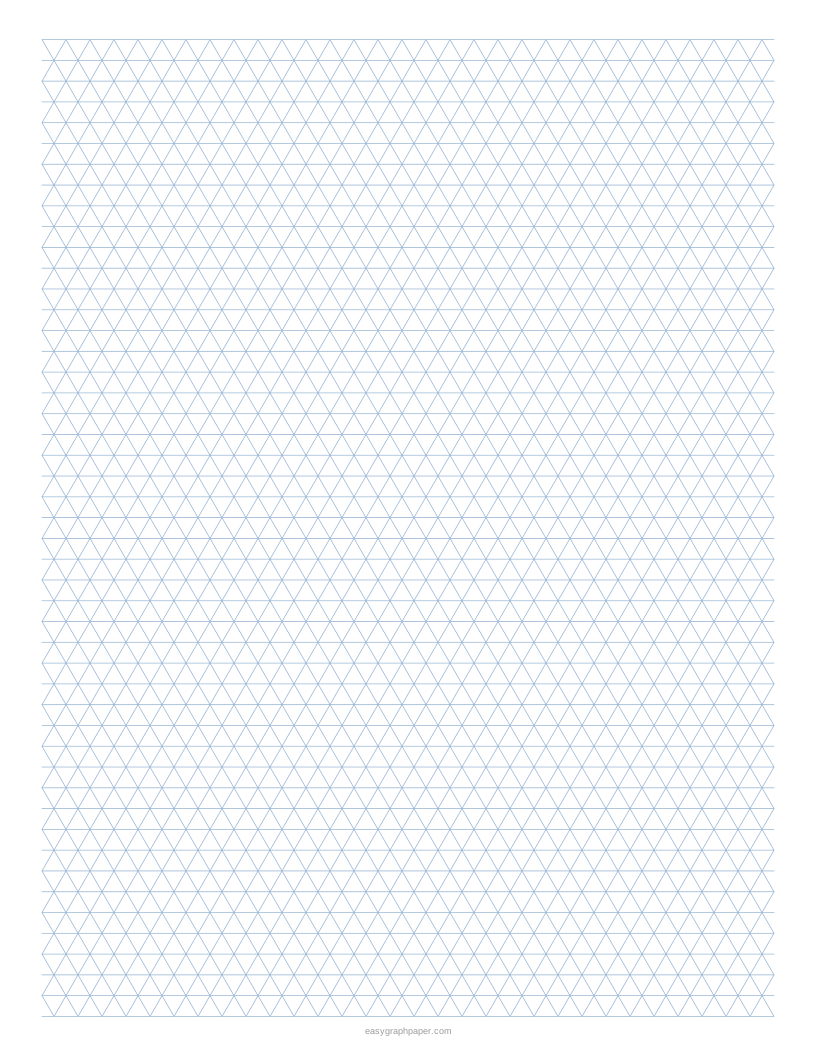
- Choose a direction: “Vertical lines (standard)” or “Horizontal lines”, which turns the same grid 90 degrees.
- If you use the dot style, set the dot size.
- Open “Page and print settings”. Set the margin, and add an optional title, a Name and Date line, or a number of pages from 1 to 50. You can also switch off the small site address in the bottom margin.
- Pick a line colour and line weight, then check the preview.
- Use Print, Download PDF, SVG or Copy link under the preview.
To keep the triangles at the size you set, print at 100 % or “Actual size” and turn off “Fit to page” or “Shrink to fit” in the print dialog; fitting to the page shrinks the whole grid slightly. The page remembers the paper size you chose last time in your browser.
What is isometric graph paper?
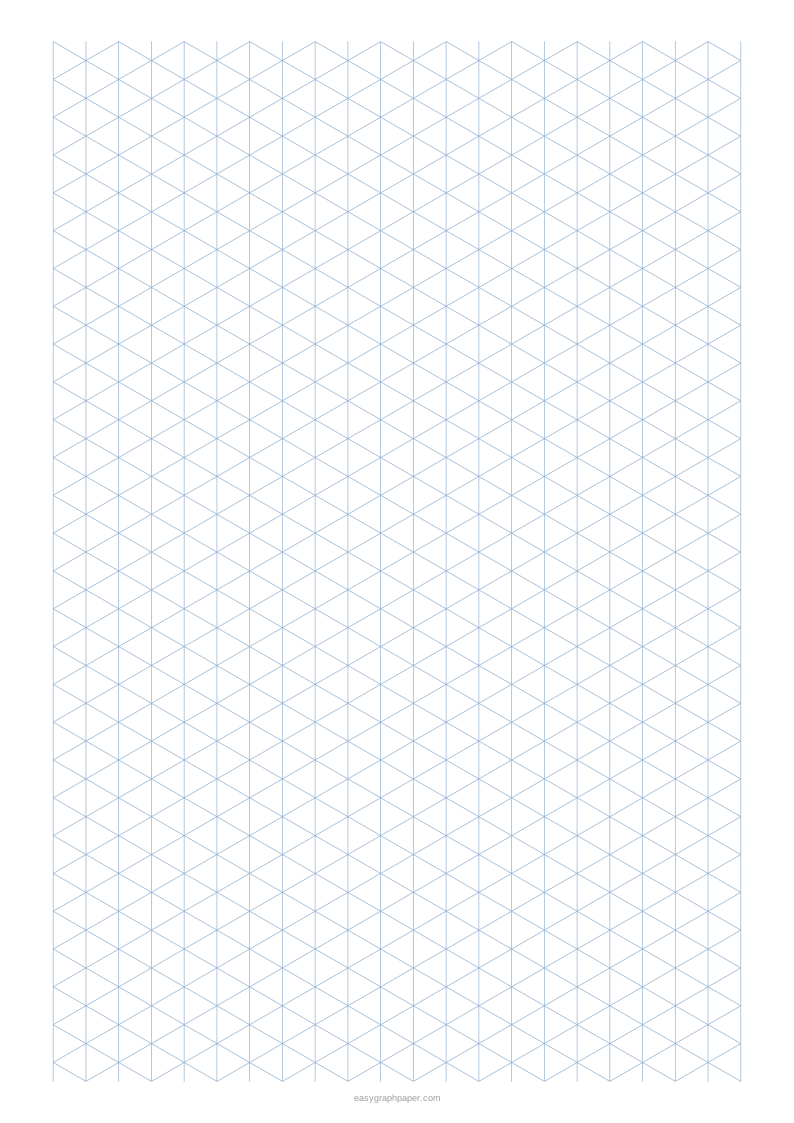
Isometric graph paper is grid paper made of equilateral triangles, with lines running in three directions that are 60 degrees apart. In the standard orientation, one set of lines is vertical, and the other two slope at 30 degrees above and below the horizontal. Each family of parallel lines is the same distance apart, so the three directions can stand for the three axes of an object: height, width and depth.
In an isometric drawing, the height of an object runs along the vertical lines, and its width and depth run along the two 30-degree lines. Equal lengths in all three directions are drawn equal, so a cube looks like a cube on the page. The vertical lines sit side × 0.866 (√3/2) apart. For 1 cm triangles, that spacing is 8.66 mm.
How to draw on isometric graph paper
- Pick a corner of the object that faces you and mark it on a grid point.
- Draw the vertical edges along the vertical lines, counting one triangle side per unit of height.
- Draw the width along one 30-degree line and the depth along the other, counting triangle sides again.
- Join the ends to close each face; on a cube the three visible faces become three rhombuses.
- Erase or skip hidden edges, then shade one face light, one medium and one dark to make the shape read as solid.
Curves and circles become ellipses in isometric view, so sketch them inside an isometric square (a rhombus) first.
What angle is isometric paper?
The lines on isometric paper are at 30 degrees above and below the horizontal, plus a vertical set. Any two of the three line directions are 60 degrees apart. When you draw the corner of a cube, the edges meet at 120 degrees, not at a right angle.
Isometric drawing does not use vanishing points, which is the main difference from perspective drawing. Objects keep the same scale no matter how far they are from the viewer. That makes measurements easy to read off the grid.
Examples made with this generator

Frequently asked questions
What is isometric paper used for?
It is used for technical sketches, 3D shapes and cube drawings in maths class. It also helps plan game levels and room layouts, and it appears in quilting and tessellation patterns.
What is isometric dot paper?
Isometric dot paper places a dot at every corner of the triangles. In each column, the dots are one side length apart, and neighbouring columns are shifted by half a side. It is useful when you want the grid structure without the lines.
Does isometric drawing use perspective?
No. Isometric drawing has no vanishing points, so parallel edges stay parallel on the page. Perspective drawing does use vanishing points, which makes distant objects look smaller.
What triangle size should I use?
For sketching objects and maths homework, 1 cm or 1/4 inch triangles are a good start. Use 5 mm for detailed technical sketches, and 1/2 inch or 1 inch for young students or large drawings.
Do I need to sign up or install anything to make isometric graph paper?
No. The generator is free, needs no sign-up and needs no download. It draws the sheet in your browser as vector graphics.
Can I print isometric paper on A4 or A3?
Yes. Choose A4, A3 or any other listed size; the triangles keep the side length you set and more of them fit on the larger sheet.
Related paper templates
- Dot grid paper: Use it when you want a square grid of dots rather than triangles.
- Graph paper generator: Use it for standard square graph paper for plotting and maths.
- Hex grid paper: Use it for hexagon patterns, maps or board game layouts.
- Perspective grid: Use it when you want to draw with vanishing points instead of isometric angles.
- Grid paper: Use it for simple printable grid sheets for everyday notes and sketches.
- Ternary diagram: Use it to plot three-part mixtures on a triangular diagram.